
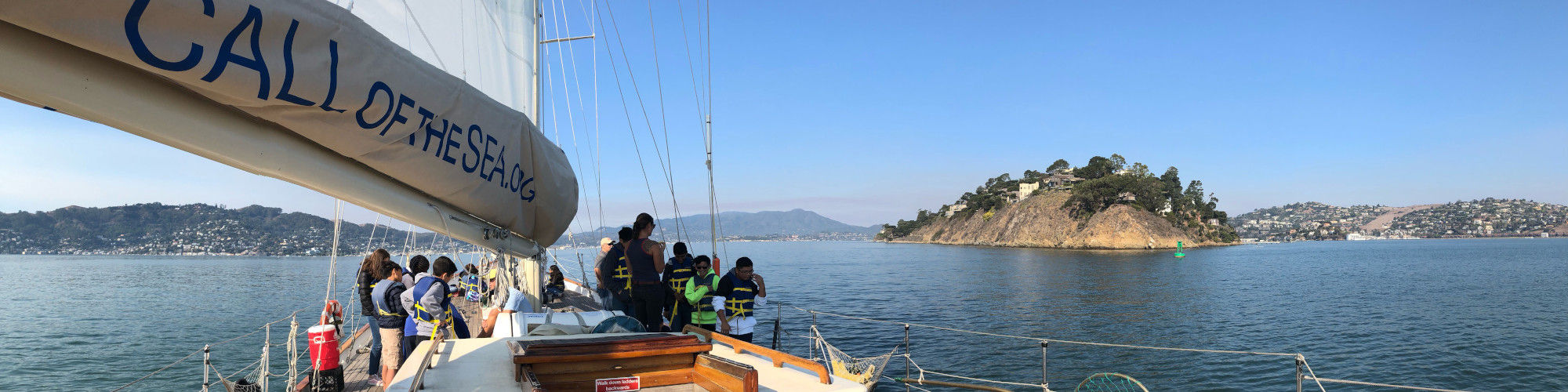
Bay Explorations: Outdoor Education Programs
Our crew of professional educators create an environment for students to engage, participate, inquire, and discover in an unforgettable on-the-water school field trip experience.
The educational program from Call of the Sea is top notch! My chaperones both days were blown away by the organization and quality of programming. Stations were engaging, thoughtfully planned, and responsive to the students in the moment. Hanna Dracker–James B Davidson Middle School
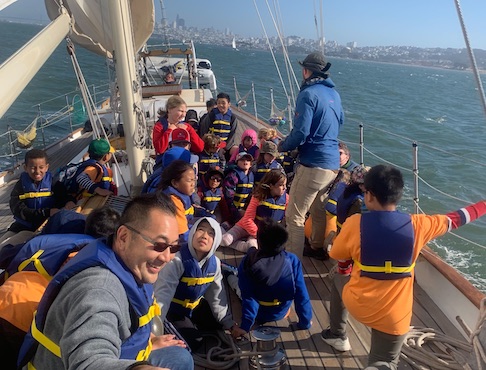
Available on both Seaward and Matthew Turner
Bay Exploration Sails provide an immersive outdoor experience where students have the opportunity to connect with the marine environment. With San Francisco Bay as our classroom, students participate in a series of small group rotations where our crew lead hands-on activities through experiential education focused on marine and nautical sciences. Our day sails are designed to inspire the next generation with a curiosity and care for our ocean environment. Day Sail Programs are 3 hours with the possibility to extend time frames and/or include dockside learning for larger or specialty groups. Our crew will do their best to accommodate any program requests based upon the discretion of the education department. Check out our generalized program and activity outlines below:
Select your program package below for an interdisciplinary educational sail tailored for the age level, Grades Four through College. Please contact info@callofthesea.org for program information and prices.
Call of the Sea Classic
Students will use pelts, baleen and skull models to understand key features of Marine Mammals in the SF Bay such as whales, harbour seals and California Sea Lions. Students will become naturalists on board, with a real-life opportunity to spot our aquatic neighbors while on deck. Working with our partners at the Oceanic Society, some groups will be able to name and track frequent visitors migrating in and around the bay.
Students will learn age-appropriate facts and terminology surrounding the world of plankton as well as their importance in the food chain, decomposition, and oxygen production. Students will deploy a scientific grade mesh net to collect a bay sample that will be explored under a digital microscope below deck. For advanced-level participants on extended and overnight voyages, students will complete a full microscopy and identification process of their findings. Select groups will have their samples forwarded to the CA Department of Public Health as participation in a statewide water quality monitoring program which can be viewed online.
Students will learn how to read a nautical chart and use a handheld compass. Once students understand the basics of both, they will be given a series of tasks such as finding a bearing, identifying a landmark or plotting a point on the chart. High school students will be able to incorporate math skills in order to practice more advanced navigation techniques alongside the crew.
Students will learn one of the most important skills of a sailor, how to tie knots. Working with a crew member, students will identify several knots used on the vessel and then practice tying them. Once the skill has been mastered, some students will have the chance to apply their knowledge by helping the crew with fenders and sail ties.
Oceanographer for a Day
Students will use pelts, baleen and skull models to understand key features of Marine Mammals in the SF Bay such as whales, harbour seals and California Sea Lions. Students will become naturalists on board, with a real-life opportunity to spot our aquatic neighbors while on deck. Working with our partners at the Oceanic Society, some groups will be able to name and track frequent visitors migrating in and around the bay.
Students will learn age-appropriate facts and terminology surrounding the world of plankton as well as their importance in the food chain, decomposition, and oxygen production. Students will deploy a scientific-grade mesh net to collect a bay sample that will be explored under a digital microscope below deck. For advanced-level participants on extended and overnight voyages, students will complete a full microscopy and identification process of their findings. Select groups will have their samples forwarded to the CA Department of Public Health as participation in a statewide water quality monitoring program which can be viewed online.
With pre-collected live samples of marine organisms from our docks, students will get an up-close look while they learn to identify and understand the importance of filter feeders such as mussels and tunicates in the SF bay. For advanced groups, students will take the time to identify and understand invasive species and how they are transported in ballast water. Subject to the discretion of the crew, students will be able to touch and hold their newly-found marine friends. Every sample is different, ranging from filter feeders to tanks with fish and crabs.
Conducting a basic experiment in a cup, students will learn the effects of CO2 on the marine environment since the Industrial Revolution. For middle school groups, students will collect a sample of bay water, add a pH indicator, and blow bubbles, seeing in real time the change of pH and discussing the consequences for marine animals and humans.
Sailor for a Day
Students will learn how to read a nautical chart and use a handheld compass. Once students understand the basics of both, they will be given a series of tasks such as finding a bearing, identifying a landmark or plotting a point on the chart. High school students will be able to incorporate math skills in order to practice more advanced navigation techniques alongside the crew.
Students will learn one of the most important skills of a sailor, how to tie knots. Working with a crew member, students will identify several knots used on the vessel and then practice tying them. Once the skill has been mastered some students will have the chance to apply their knowledge by helping the crew with fenders and sail ties.
A crew-guided tour below, where students will observe the traditional quarters of a live-aboard crew. During the tour, students will be able to ask questions about life at sea and living in a nautical community. For smaller groups, students will have a quick chance to try out a bunk and/or check out the engine room.
With the supervision of the Captain and officers, students will steer the vessel and learn the importance of these roles of leadership.
Testimonials:
“Just wanted to send a big thank you to you, your group and the captain for my class trip on Wednesday. The students really enjoyed the cruise and was wonderful to get them out to experience being on the water. The activities enhanced a number of the things we have been covering in class, and I know I will be saying “remember on the Seaward ….” many times for the rest of the semester. Appreciated all of your enthusiasm, and especially giving the students a look at the interesting jobs you all have.”
“Your crew is so very kind, patient and understanding with our 4th graders! You all made the students feel heard and important as they engaged in the activities aboard the Matthew Turner.”